
Photoshop’s Generative Fill can pull off some genuine magic, but let’s be real for a second: whenever you try dropping hair onto a bald head, half the attempts look like a cheap Halloween toupee pasted on in MS Paint.
You've probably seen those flawless social media demos where everything clicks on the first try. In practice, it takes a little more finesse, so consider this the honest rundown.
I’ll walk you through the straightforward 5-step workflow to get convincing hair with AI. More importantly, we’ll dig into why the results can look funky right out of the gate (and how to fix them), drawn straight from hands-on trial and error.
How to Add Hair with AI in Photoshop (The 5-Step Method)
The core workflow only takes a minute, but the overall realism rides almost entirely on two things: how clean your selection is in Step 1, and what you type into the prompt box in Step 3.
Step 1: Open Your Image & Select the Area (Lasso Tool)
Start by opening your picture. You’ll have a much easier time with a clear, straight-on portrait where the head shape and facial features aren't blocked by harsh shadows.
Grab your Lasso Tool (hit L on your keyboard) and draw a loop right over the zone where you want the new hair to sit. Don't rush this part - it sets the foundation for everything else.
For short styles (like a buzzcut): Keep your selection snug along the natural contour of the skull.
For longer styles: Give it breathing room. Run your selection across the upper forehead and pull it down behind the ears so the hair has actual space to drape down.
The general rule of thumb here is simple: shape the boundary around the final silhouette you want to see, not just the bare skin you're covering.
Step 2: Activate Generative Fill
Once you close the loop and your marching ants are dancing, you’ll see the floating Contextual Task Bar pop up beneath it. Just click that Generative Fill button to open the prompt field.
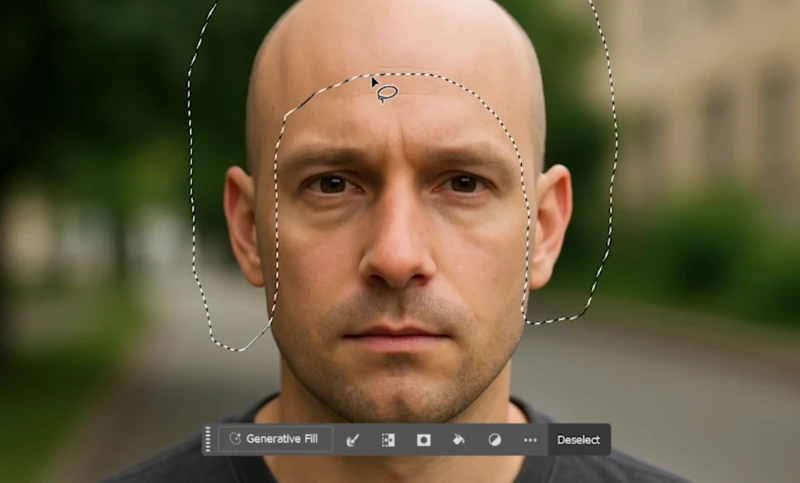
Step 3: Write Your Prompt (English is Key)
A small input box will appear, waiting for your instructions. Describe the haircut you have in mind plainly. From our testing across multiple setups, sticking to English prompts consistently gives you cleaner textures and avoids weird visual glitches.
Keep things simple to start. Type a basic description (something like "black hair") and hit the Generate button.
Step 4: Generate and Review the 3 Variations
Under the hood, Firefly scans your photo’s ambient light, shadows, and overall perspective to try and blend the new strands into the original scene smoothly.
Give it a few seconds, and Photoshop will kick back three distinct variations. You’ll find them stacked neatly in the Properties panel under "Variations." Click through each thumbnail to see which direction came closest to matching the shot.
Step 5: Refine Selection or Regenerate
If all three drafts look a bit off, don't sweat it. That happens all the time with hair, so you definitely shouldn't scrap the project.
Roll the dice again: Hit Generate a second time without changing anything. The model will roll three completely fresh takes off that same prompt.
Tweak your wording: Swap out your phrasing slightly (try typing "wavy dark hair" instead of a flat "black hair").
Fix your boundary: If the hair is sprouting from an awkward spot or floating off the skull, your selection shape threw the AI off. Press Ctrl/Cmd + D to drop the selection, and re-draw it in Step 1.
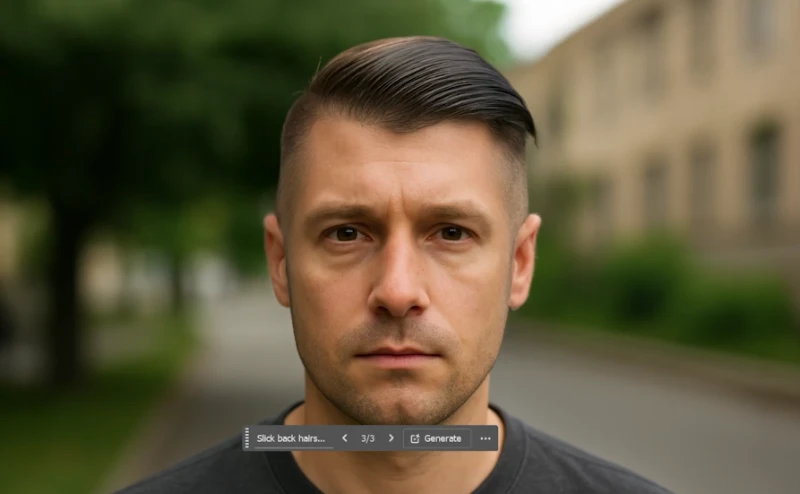
Why Does My AI Hair Look Fake?
Honestly, this is where most people get tripped up. The underlying tech is remarkably capable, but it still guesses blind sometimes. Here are the main traps we ran into during testing and what you can do to straighten them out.
Problem 1: It Looks Like a Wig or "Fake"
This is by far the biggest issue you'll run across. The individual strands might look sharp, but the whole piece sits on the skull like an ill-fitting toupee.
The Cause: Nine times out of ten, the model missed the direction or warmth of your ambient lighting and cast shadows. Because the hair isn't catching the same light as the forehead, the brain instantly spots the disconnect.
The Fix: Often, hitting generate two or three more times gives the algorithm another chance to latch onto the right light source. If it still won't play nice, drop a blank layer on top, grab a soft brush, and paint a gentle shadow right along the root line to anchor the hair down.
Problem 2: Hair is Growing from the Middle of the Forehead
You run the generation, only to discover the AI decided the hairline belongs halfway down between the temples and the eyebrows.
The Cause: This almost always traces back to a sloppy selection outline. You probably pulled the Lasso loop down too far onto the brow, or caught parts of the forehead skin by mistake.
The Fix: Step back with Ctrl/Cmd + Z and redraw your boundary. Keep the lower edge resting right where a genuine hairline naturally sits so the model understands where the skin ends.
Problem 3: The Style Looks Unnatural (or Goes the Wrong Way)
You asked for flowing locks, but the strands are drifting sideways against gravity, or you asked for a fringe and ended up with a solid plastic helmet.
The Cause: This typically strikes when you're working with tilted or unusual camera angles. The AI gets tripped up trying to map 3D head rotation. Overcomplicating your prompt with five different styling words can also confuse it.
The Fix: Strip your prompt down to clear, concise terms. If the photo was shot from an extreme high or low angle, the algorithm might genuinely struggle with the perspective on that particular frame.
The Best Prompts for Realistic Hair (Examples We Tested)
What you feed the prompt bar carries massive weight. Short, focused descriptions almost always beat out long paragraphs full of flowery adjectives.
Here are a few straightforward prompts that handed us clean, believable hair within one or two passes:
"Short black hair"
"Curly brown hair"
"Long straight blonde hair"
"Buzz cut" (This one renders surprisingly clean stubble)
"Wavy dark hair"
"Slicked back hairstyle"
You can tinker with these as much as you like, though once you get the hang of Generative AI, you can take it way beyond retouches - like creating a custom action figure of yourself directly from a standard portrait.
Prompts That Can Fail (Based on Our Tests)
On the flip side, cramming too many competing requirements into a single sentence tends to give the model tunnel vision.
During our testing, we fed it "messy curly hair with bangs." The AI generated fantastic messy curls every single round, but it completely ignored the bangs across all three drafts. That's just where the tool sits right now. When it skips a detail, stick to a basic prompt first, then make a second tiny selection just over the forehead to generate the bangs on their own.
A Surprising Use: Virtual Hair Transplant Previews
Beyond quick touch-ups or funny edits for friends, a lot of folks are quietly using this feature as an informal consultation tool to preview how they'd look after a hair transplant.
By loosely circling just the thinning patches or a receding hairline and punching in something like "short black hair," you can visualize how different densities and styles frame your face before ever sitting down with a specialist.
Quick Requirements: What You Need to Use This Feature
Keep in mind that you can't just boot up an old copy of CS6 and find this tool. You need two basic things in place before you can use it:
A modern version of Photoshop (2023 release or newer). The Generative Fill engine simply doesn't exist in legacy standalone versions.
A reliable internet connection. All the heavy neural processing runs directly on Adobe’s cloud servers rather than your local GPU. If your machine is offline, the feature stays completely greyed out.